Two large grants awarded to the research group

The research group recently was awarded with two large research grants.

The first “Incels and the manosphere” will explore the incel movement and misogynistic radicalization in Sweden. The grant was awarded by Forte, for three years.

The second “A divided digitalized democracy” will explore affective polarization as a spiral between the political elite and the masses. This grant was afforded by Vetenskapsrådet, for three years.

New paper on radicalization

Holly, Emma and Magnus just published a new paper on radicalization in the backdrop of the abortion divide in the US. The paper titled The abortion divide: Exploring the role of exclusion, loss of significance and identity in the radicalization process was published in Frontiers and can be found here.

Abstract

Introduction: Recently, the abortion issue has entered the spotlight in the USA, leading to potential radical actions. As the majority opinion on the abortion issue vary with state, some individuals will be in the numerical minority within their state, possibly evoking feelings of exclusion. Social exclusion can motivate a radicalization process. The aim of this paper is to explore how individuals in a numerical minority experience feelings of exclusion and significance loss and how this may drive radicalization in the context of the abortion issue.

Methods: A quasi-experimental design was used and 534 respondents from naturally occurring numerical minority and majority groups based on state abortion opinion participated in an online survey.

Results: Results showed that those in the numerical minority experienced exclusion and were more willing to engage in and endorse radical actions compared to those in the majority, regardless of position on the abortion issue. Serial mediation analysis revealed that the pathway between minority group status and engagement and endorsement of extreme actions was fully mediated by need-threat and ingroup identity.

Discussion: Being in the numerical minority is associated with feelings of social exclusion, which may trigger a radicalization process. The results advance our understanding of when and who is vulnerable to radicalization and that social structures that perpetuate marginalization and inequality may contribute to radicalization. Results highlight the need to continue to explore radicalization from a group-based perspective and emphasize exploring mediating factors as a pathway from social experiences to willingness to engage with radical groups.

Hanna interviewed about potential effects of affective polarization on government formation (in Swedish)


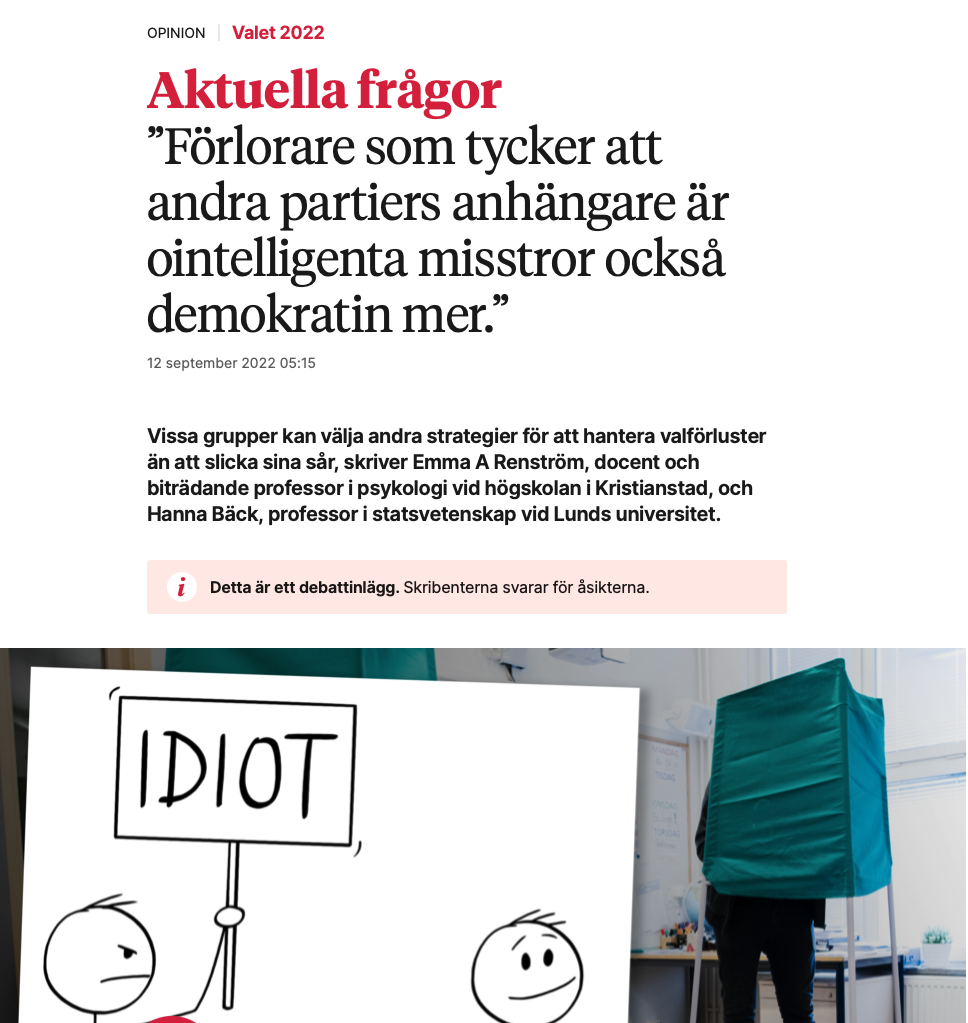
Med en dryg vecka kvar till valet är tonläget i politiken högt och polariseringen tydlig. Men skiljaktigheterna handlar inte bara om ideologi och åsikter. Man är också benägen att tycka att motståndarna är oärliga, ointelligenta och fördomsfulla. Det visar forskare vid Lunds och Göteborgs universitet i en studie om så kallad affektiv polarisering.

Läs hela inlägget från Lunds universitets hemsida här.


New blog post about affective polarization (in Swedish)

Hanna och Emma har skrivit ett blogg-inlägg på Makt och Politik om affektiv polarisering.

Valrörelsen är i full gång och partiernas representanter uttalar sig i mer eller mindre negativa ordalag om motståndarsidan och utmålar vissa andra partier som fiender. Detta kan ha stor betydelse för hur väljarna ser på andra partier och deras anhängare, och för den så kallade polariseringen i väljarkåren.

Sympathizing With the Radical Right: Effects of Mainstream Party Recognition and Control of Prejudice

A new paper in the Journal of Social and Political Psychology about how mainstream party recognition increase sympathy for the radical right.

The electoral success of radical right parties throughout Western Europe is the biggest change to these formerly stable party systems. Several studies have identified that mainstream parties can shape the trajectory of radical right parties. Our aim is to contribute to this literature, and to investigate if and how radical right parties gain from mainstream party recognition. Theoretically, we draw on the literature that has suggested that when aiming to explain the legitimization of radical right parties, we need to consider that many individuals in Western Europe are influenced by an anti-prejudice norm when forming preferences towards such parties. We hypothesize that when mainstream parties signal that it is acceptable to associate with radical right parties' they challenge the anti-prejudice norm that dissuade voters from such parties. In addition, individuals with lower internal motivation to control prejudice (IMCP) are more susceptible to be affected by mainstream party recognition of radical right parties as those with high IMCP have a stronger internalized anti-prejudice norm. We evaluate the effects of changes in the normative context in a survey experiment (N = 1133) by manipulating mainstream party legitimization of a radical right party, the Sweden Democrats, before the Swedish parliamentary election in 2018. Our results suggest that when mainstream parties challenge the anti-prejudice norm, individuals are more likely to sympathize with radical right parties. Moreover, the effect of mainstream party recognition is moderated by IMCP-individuals with a low motivation to appear non-prejudiced are more influenced by mainstream party legitimization of a radical right party.

The article can be found here.

Protecting the Ingroup? Authoritarianism, Immigration Attitudes, and Affective Polarization

A new paper on the effects of RWA on affective polarization is out in Journal of Social and Political Psychology.

What makes people affectively polarized? Affective polarization is based on the idea that partisanship can be a social identity leading to polarization in the form of intergroup distancing between the own party and the other parties. In this study, we argue that perceived threats from an outgroup can spur affective polarization. To investigate this, we use the issue of immigration, often framed as a threat by right-wing groups, to examine whether individual-level differences influence how sensititivity to the perception of immigration as a threat. One such factor is the trait right-wing authoritarianism (RWA), which is characterized by emphasis on submission to authority and upholding norms of social order. The emphasis among individuals with this trait on protecting the ingroup from threats means that negativity toward immigration is likely to extend toward political opponents, resulting in an increase in affective polarization. Thus, we hypothesize that the affective polarization is likely to increase when individuals interpret immigration as threatening, particularly for the individuals who are high in RWA aggression. We evaluate and find support for this claim using a large-scale survey performed in Sweden ( N = 898). The results, showing a conditional effect of immigration attitudes on affective polarization, are consistent across three commonly used measures of affective polarization as follows: trait ratings, a social distance measure, and feeling thermometers. Overall, our results show that it is important to consider intergroup threats and intergroup differences in the context of sensitivity to such threats when explaining affective polarization.

The paper can be found here.

Student thesis on misogynistic radicalization

Kim Holm and Matilda Plume, clinical psychologist program at the University of Gothenburg, has written a thesis on misogynistic radicalization with Emma as supervisor. The thesis is entitled: Misogynistic radicalization on the Manosphere – exploring the effects of entitlement and negative emotions  can be downloaded here.

Abstract

During the last decade the online milieu known as the manosphere has been connected to numerous lethal deeds and acts of violence against women. The overarching purpose of this study was to gain a deepened understanding of the processes of online misogynistic radicalization. Drawing on theories on radicalization, masculinity, and the effects of emotions, we designed and conducted an online survey-based experiment to examine how average men can become misogynistically radicalized towards using or condoning violence. The experiment randomly assigned 596 American men to read fictional tweets designed to either threaten their masculine social identity or to be non-threatening. We used a model of moderated mediation, with entitlement as a moderator and negative emotions as mediators between the threat condition and measures of misogynistic radicalization. Our results showed that threatening messages increased negative emotions. Specific emotions had unique effects, with disgust and fear increasing measures of radicalization. Additionally, the effects of disgust on radicalization were moderated by degree of entitlement. Our results provide experimental evidence for processes of misogynistic radicalization occurring online, and its relevance to the general radicalization research field is discussed.

Affective polarization in a multiparty system

Intergroup Threat and Affective Polarization in a Multi-Party System

Emma A. Renström, Hanna Bäck & Royce Carroll

Abstract

What explains affective polarization among voters and societal groups? Much of the existing literature focusing on mass political polarization in modern democracies originates in the US, where studies have shown that, while ideological separation has grown, political conflict increasingly reflects social identity divisions rather than policy disagreements, resulting in affective polarization. We focus on explaining such polarization in a multi-party context. Drawing on social identity theory and intergroup threat theory, we hypothesize that individuals who perceive an intergroup threat show stronger intergroup differentiation and increased affective polarization. We analyze the influence of perceived threat on affective polarization drawing on two large-scale representative surveys in Sweden (N = 1429 and 1343). We show that individual-level affective polarization is related to perceived intergroup threats among the voters in both studies, measuring affective polarization using social distance, negative trait attribution, and party like-dislike ratings.

Find the full paper published in Journal of Social and Political Psychology here.

New article on personality and compliance with recommendations during Covid

Who Follows the Rules During a Crisis?—Personality Traits and Trust as Predictors of Compliance With Containment Recommendations During the COVID-19 Pandemic

Yvonne Schmeisser, Emma A. Renström & Hanna Bäck

When the COVID-19 pandemic hit in 2020, many governments tried to contain the spread of the virus by legally restricting social life and imposing national lockdowns. The Swedish government did not enforce a national lockdown, but instead appealed to the individual’s self-responsibility to follow specific containment recommendations developed by the Swedish Public Health Agency. Sweden is thus an especially interesting case to study because of the potential influence of psychological and attitudinal individual-level factors that might contribute to compliance with containment recommendations. Drawing on previous literature on how individuals respond during health crises, we define and evaluate a mediation model that considers the role of personality traits and trust authorities to explain compliance. More specifically, we argue that we need to consider the role of trust in authorities to better understand the relationship between personality traits and compliance. In analyses based on a large-scale representative survey (N = 1,034), we find Conscientiousness to be directly linked to compliance, whereas Agreeableness, Neuroticism and Openness were indirectly related to compliance when trust in the Public Health Agency was taken into account.

Find the full paper published in Frontiers in Political Science here.

Two new articles on the political psychology of Covid-19

In two recent papers, we explore the role of emotions in reactions to Covid-19 policies, political actions and health-related behaviors. The papers are published open access and are linked below.

Anxiety, Compassion and Pride. How emotions elicited by the Governments handling of Covid-19 influences health-promoting behaviors.

Emotions during the Covid-19 pandemic: Fear, anxiety and anger as mediators between threats and policy support and political actions.