

Hanna and Emma have co-authored a chapter for a new SOU report (Governmental Public Investigations). The report can be found in PDF here (only in Swedish).
Pop-Rad presents at Nordic Political Science Association
Hanna and Emma presented work from Pop-Rad at the Nordic Political Science Association's Political Psychology workshop in August in Odense.
Abstract
The present research aims to determine how the so called quest for significance plays into the radicalization process. Humans innately seek significance, for instance self-worth, value and respect. Loss of significance elicits a search for ways to re-establish self-worth, value and respect. One way to achieve this is by adherence to a radical ideology. We here analyze social exclusion as a type of significance loss, and establish effects on adaption to a radical group. Social exclusion has been shown to affect individuals in a similar manner as a more general ‘significance loss’ – social exclusion threatens basic human needs for affiliation, belongingness and the desire to ‘be somebody’. Following social exclusion, individuals are more prone to adapt to others who provide an opportunity for inclusion. We use a validated online experimental manipulation of social exclusion that takes the form of a social media platform, similar to Facebook. Two studies show that excluded individuals, especially those highly sensitive to rejection, were more likely to identify as a right-wing/left-wing activist after having been included into a radical right-wing/left-wing group. They were also more likely to want to join the radical group that included them following exclusion. Hence, our results show that the mechanism of significance loss is independent of ideological content, and works the same for individuals to the left and right of the political spectrum, which in line with the significance quest model of radicalization.
Pop-rad invited to Nordic conference on research on violent extremism
Between the 24th-26th of April Niklas Altermark and Emma Bäck from the Pop-Rad project are invited to participate in the Nordic conference on research on violent extremism, hosted by the Segerstedt Institute in Gothenburg. The the of the conference is 'Risk, Roots and Responses', and Niklas Altermark and Emma Bäck will both present research on the issues.
More information in the link below:
http://segerstedtinstitutet.gu.se/english/collaborations/risks-roots-responses
Research Presentation at the Segerstedt Institute
On March 15th, Emma Bäck will present her research under the topic 'Social Factors Explaining Political Factors and Radicalisation' at a seminar hosted by the Segerstedt Institute in Gothenburg. Bäck will present Pop-Rad projects research results indicating that the individual´s strive for acceptance and fear of rejection may contribute to the likelihood of participating in political protests and even radicalisation.
For more information, see link below:
http://segerstedtinstitutet.gu.se/aktuellt/detalj/?eventId=70131076173
Studio Ett interview with Holly Knapton
Holly Knapton is interviewed by popular radio show Studio Ett, to talk about the research project and the relationship between exclusion and radicalization.
Follow the link to read the full article and listen to the interview.
Pop-Rad joins public radio show
Karin Harborg and Niklas Altermark joined the P4 Malmö morning radio show to talk about radicalisation and violent extremism, and the counter measures implemented by the Swedish municipalities and government agencies.
Listen to the program here.
A throw from the extreme – Conference presentation
Pop-Rad attended the International Society for Political Psychology conference in Warsaw, where Emma A. Bäck, Hanna Bäck, Niklas Altermark and Holly Knapton presented the paper A Throw from the extreme: Political attitude shift following inclusion by a radical group in the cyberball paradigm.
The conference paper is available here.
The social dimensions of violence
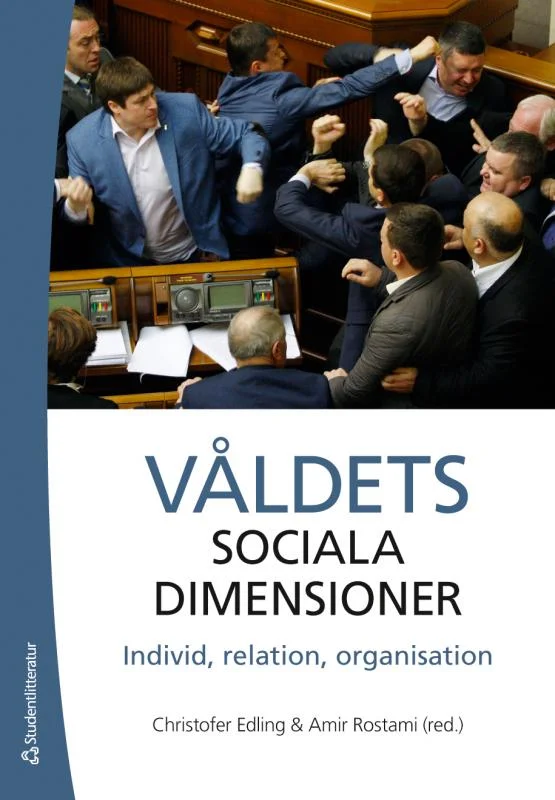
The anthology Våldets sociala dimensioner is now published. In the piece, exploring ideologically motivated violence from several different theoretical perspectives, Emma A. Bäck´s and Niklas Altermark´s chapter develops on socio-psychological perspectives on political violence in relation to sense community and rejection.
The book is available here.