

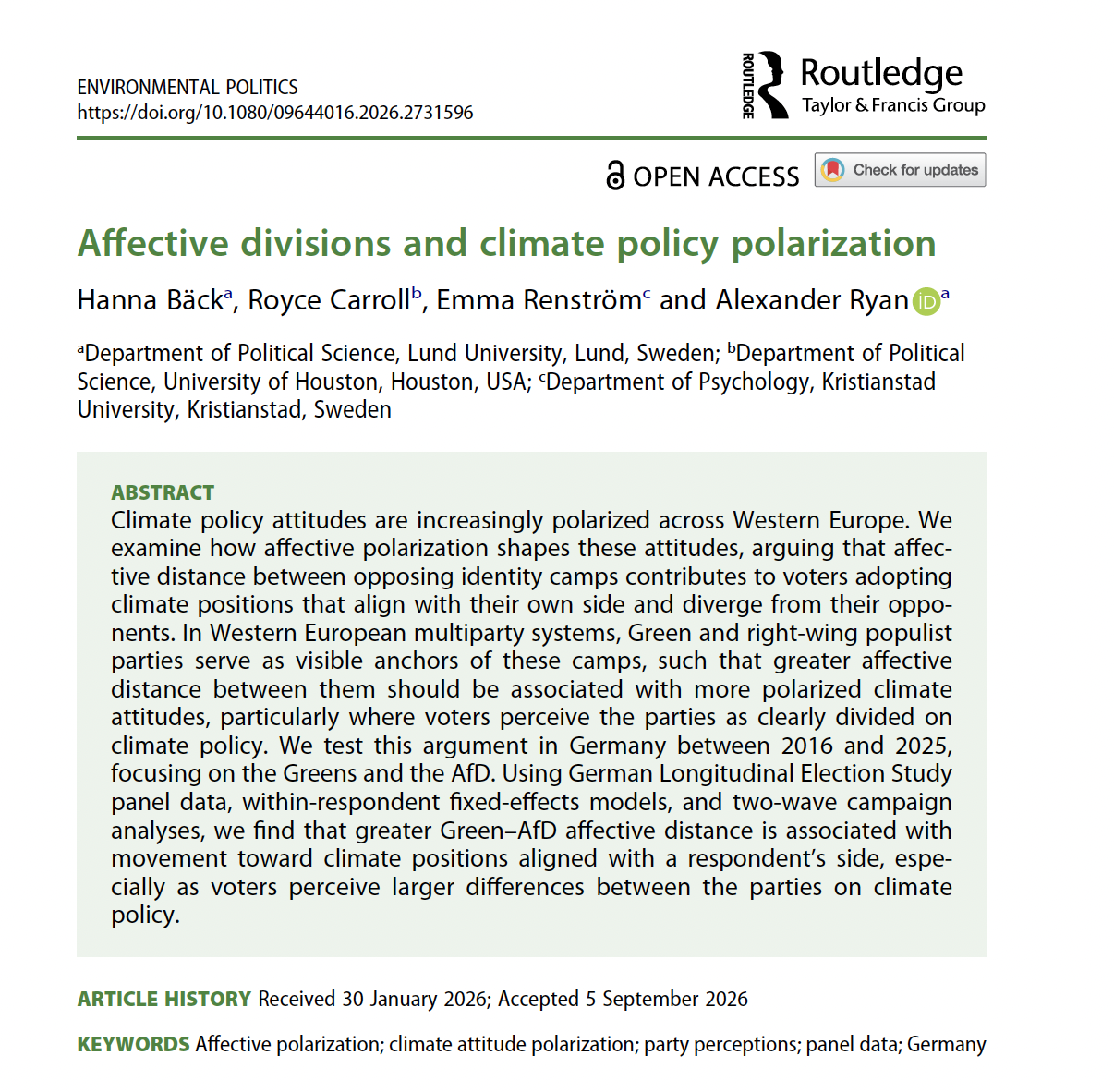
The paper was published in Environmental Politics and can be found here. The study examines how emotional hostility between supporters of Germany’s Greens and AfD contributes to polarized climate-policy attitudes. Using panel data from 2016–2025, it finds that voters increasingly adopt their preferred party’s position when they perceive a strong divide between the two parties on climate policy.
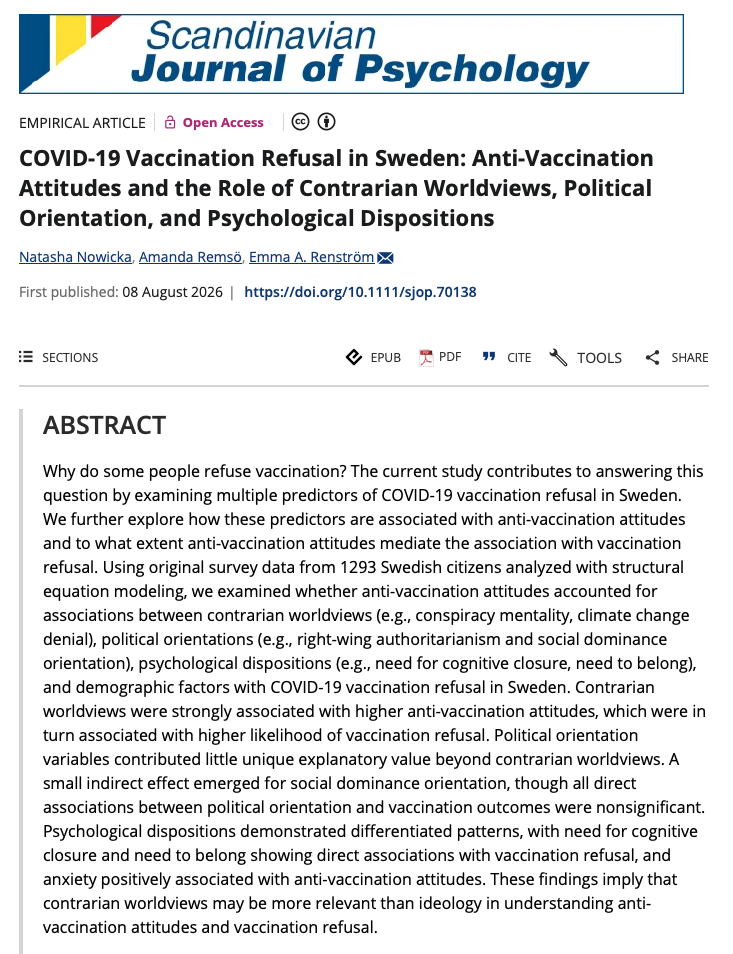
New paper on predictors of COVID-19 vaccination refusal in Sweden
In this paper, we test an extensive model of predictors for refusing to vaccinate against COVID-19 in Sweden. We find that contrarian worldviews, here including conspiracy mentality and climate change denial, emerged as the most consistent predictors of anti-vaccination attitudes and, indirectly, of refusal itself.
The article was published in Scandinavian Journal of Psychology and can be accessed here.
We have a new research assistant
Charlotte Halje recently joined our team as a Research Assistant!
Charlotte studied Psychology at Kristianstad University, where her bachelor's thesis examined the relationship between affective polarization and political tolerance. Her research interests include affective polarization, climate attitudes, psychological barriers to pro-environmental behavior, and the role of communication in shaping attitudes and behavior.

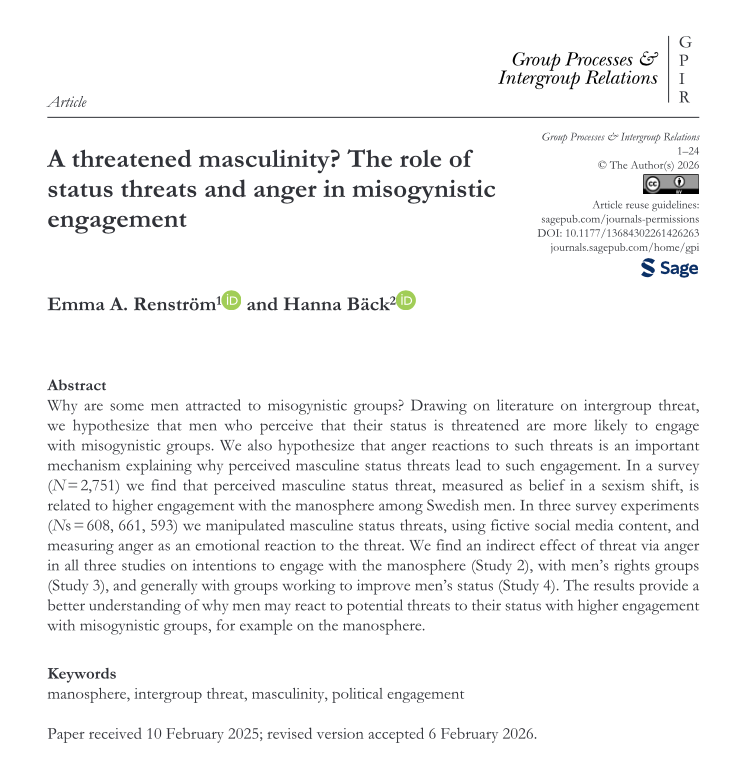
Masculinity threats increase men's intentions to engage with men's rights
In a recent paper published in Group Processes and Intergroup Relations, we show that masculine status threats increase men’s intentions to engage with the manosphere and with men’s rights groups offline. In all studies, anger evoked by the status threatening stimulus, mediated the effect of threat on engagement. The full article can be found here.
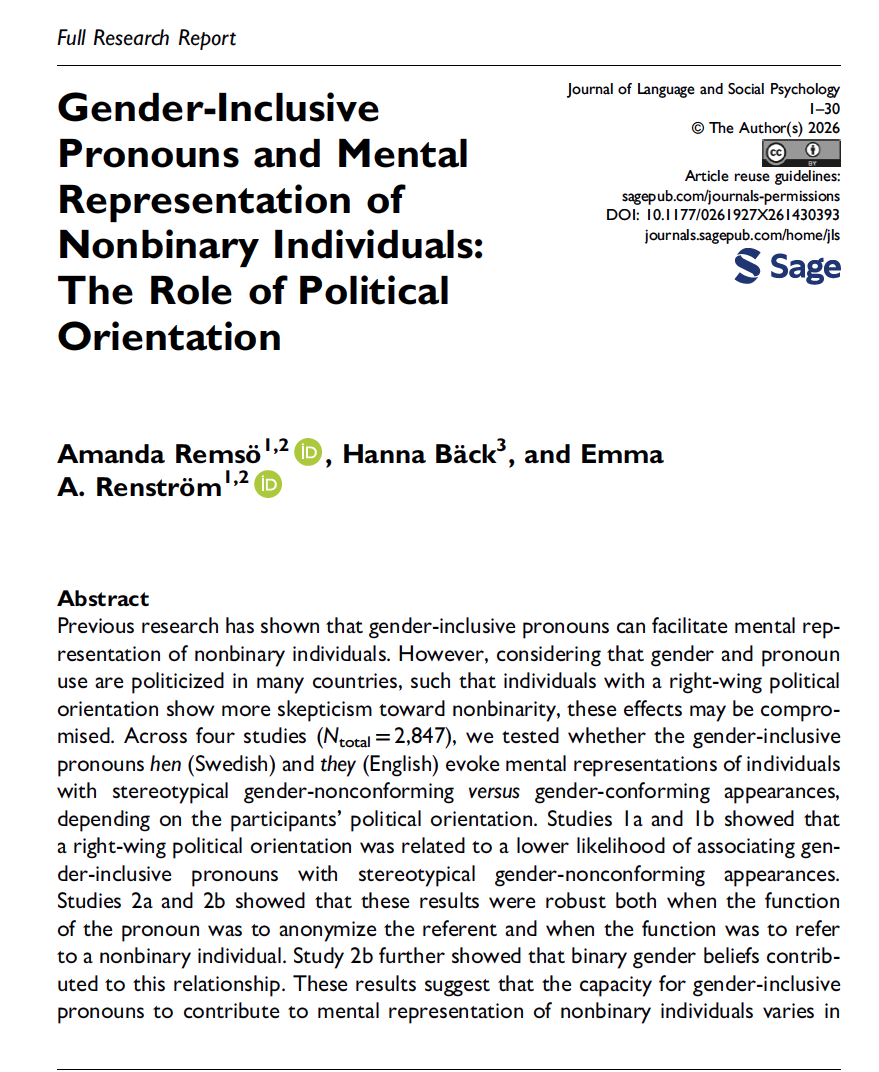
Does ideological position influence how people mentally envision non-binary individuals?
We recently explored this question in an article that was published in the Journal of Language and Social Psychology. The article can be found here.
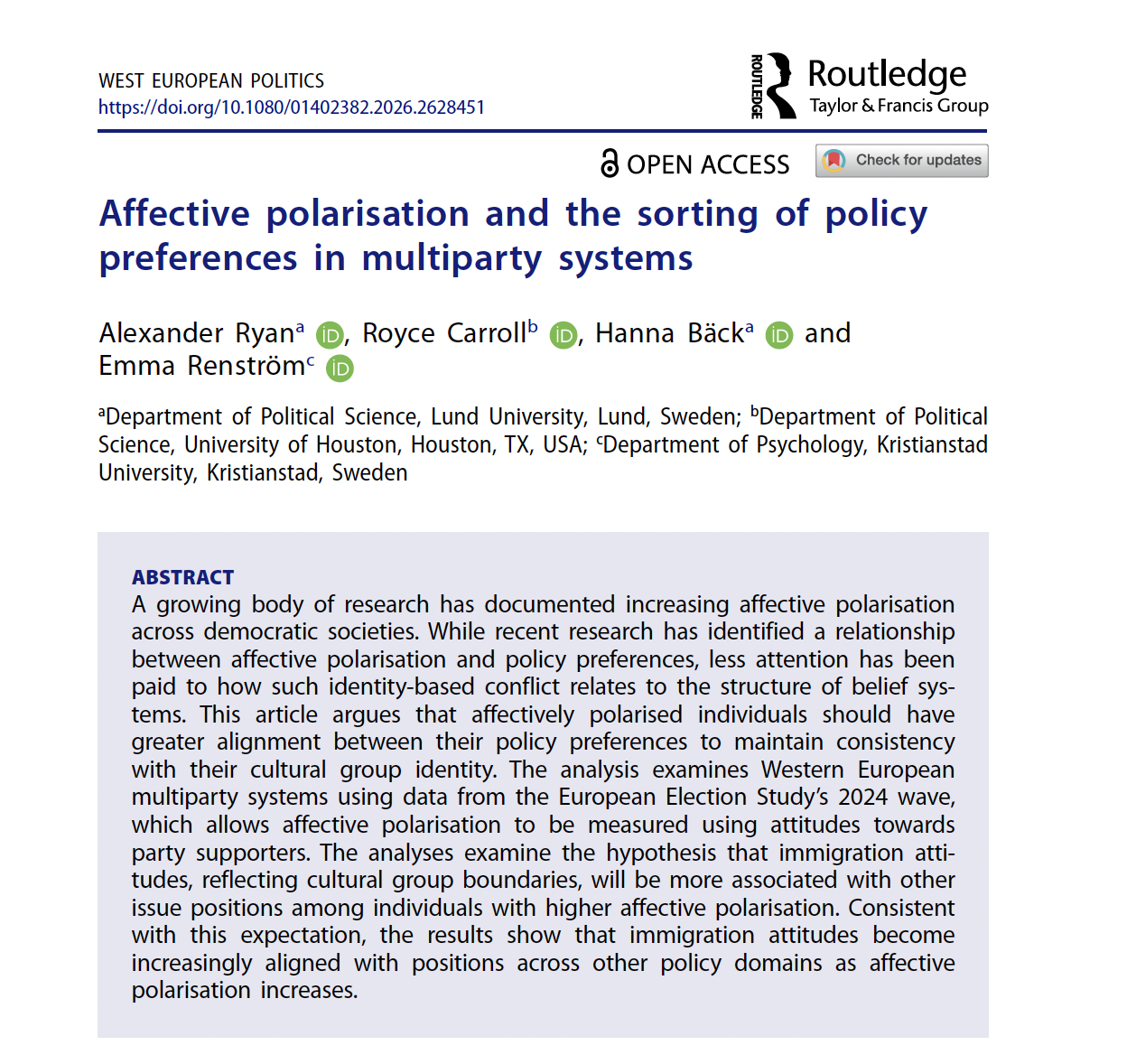
Is there a relation between affective polarization and policy sorting?
In our latest paper, we explore this association and find that affectively polarized individuals tend to be more policy sorted. The paper was published in West European Politics and can be found here.
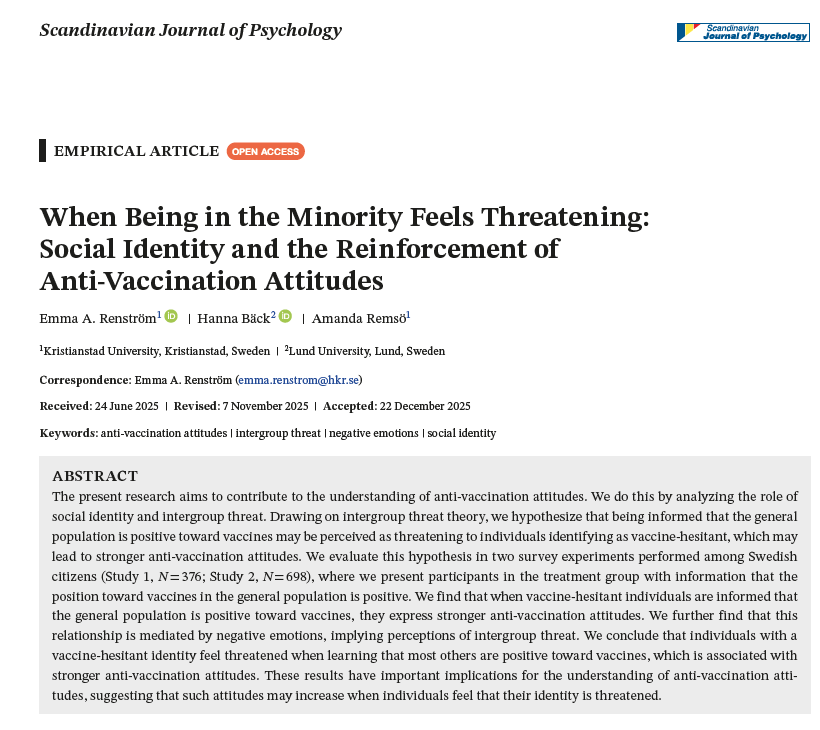
Do vaccine-hesitancy increase when individuals feel threatened?
In a new article published in Scandinavian Journal Of Psychology, we tested if intergroup threat leads vaccine-skeptic individuals to reinforce their attitudinal position in two experiments. We find that such threats do increase anti-vaccination attitudes. The article is open access here.
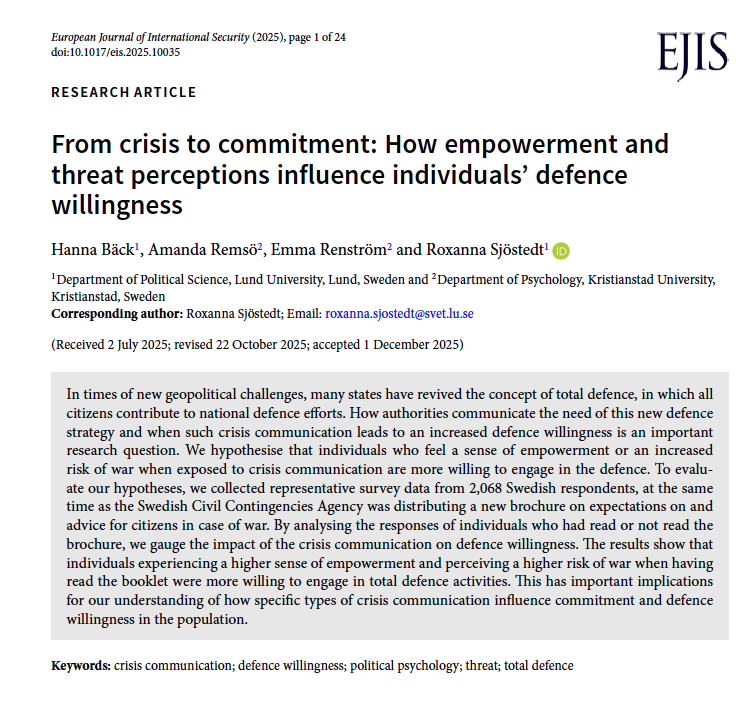
New paper on crisis communication and defense willingness
Together with Roxanna Sjöstedt, Lund University, Hanna, Emma and Amanda recently published a paper focusing on crisis communication and defense willingness among Swedes. The paper, published in European Journal of International Security, is open access here.
New project on manfluencers and violence against women
Yesterday, we were informed that our application was granted funding for three years, for a project focusing on the role of manfluencers in violence against women. The project is funded by Vetenskapsrådet. Below is a short abstract of the proposal.
Manfluencers and young men’s violence against women
Despite broader social progress, violence toward women and girls in heterosexual relationships is increasing. Concurrently, misogynistic attitudes are surging, particularly among young men in the Western world. Research indicates that these attitudes, especially the dehumanization of women, are linked to violence. This connection suggests that the rise in misogyny may help explain why some young men perpetrate violence against women.
While Sweden is often regarded as highly egalitarian, recent research suggests an ongoing backlash against gender equality. Notably, Sweden has the highest per capita number of active users on misogynistic online forums. Social media plays a crucial role in shaping young men's political attitudes, with manfluencers like Andrew Tate promoting narratives that depict women as subordinate. This project seeks to answer: How do manfluencers affect the dehumanization of women and the likelihood of violence toward women among young men?
The concerning trends of rising misogyny and violence against women among young men highlight the urgent need for new knowledge in this area. Our interdisciplinary research team, with expertise in psychology and political science, is well-equipped to address the research question. Using a research design that combines interviews with perpetrators, large-scale surveys, and social psychological experiments, the project will provide both in-depth insights and generalizable findings that can inform intervention strategies.
New article focusing on social reinforcement of anti-vaccination attitudes
The paper, The Social Reinforcement of Anti-Vaccination Attitudes: How Perceived Support Strengthens Vaccine Hesitancy Through Group Identity Processes, can be found here. It war recently published in Journal of Applied Social Psychology.
Abstract
Vaccine hesitancy and anti-vaccination attitudes are becoming increasingly problematic in several Western countries where diseases that were nearly extinct are coming back. We here explore the role of perceived social support in understanding anti-vaccination attitudes. We argue that perceptions about having social support for one′s position may influence anti-vaccination attitudes among some social groups. More specifically, we argue that individuals who identify as vaccine hesitant and perceive to have high social support will likely be strengthened in their anti-vaccination attitudes. In a representative survey (N = 1660) performed among Swedish citizens, we find that stronger identification as vaccine-hesitant is associated with a biased perception that social support for one′s position is stronger than it is. In an experiment (N = 794), we manipulate social support for vaccine hesitants, such that participants are informed that an increasing part of the population is becoming more negative to vaccines and vaccinations. We find that social support leads to positive emotions among individuals who identify as vaccine hesitants, which in turn is associated with increased anti-vaccination attitudes. The results have important implications for how anti-vaccination attitudes may spread and cement among the public based in identity concerns as well as cognitive biases.
Chapter on threats and emotions in new handbook of affective polarization
In a recently published handbook, edited by Eelco Harteveld and Mariano Torcal, Emma and Hanna write about emotions and threats in relation to affective polarization (ch. 13). The handbook is published open access and can be found here.

Does climate change threats increase affective polarization?
We explore the role of climate change threats on affective polarization in this new article in Analyses of Social Issues and Public Policy.

Why are men more negative against gender-inclusive language?
In a recently published paper, we find that this is likely due to men being more sexist compared to women. Using survey data from 2015 with almost 5000 respondents, we find that men’s stronger resistance against gender-inclusive pronouns, such as Swedish hen, is mainly connected to sexist beliefs.
The paper is published in the Journal of Language and Social Psychology.

New research assistant
Natasha Nowicka recently joined our team as a research assistant, supporting our current projects in political psychology with a focus on political polarization, gender, and climate attitudes. Natasha holds a BSc in Psychology from the University of California, San Diego, and an MSc in Psychology from Lund University. She has a strong interest in statistics and its application to the behavioral sciences. Her master's thesis employed a meta-analytic approach to examine the relationship between language proximity and the bilingual advantage. Natasha also has prior experience working as a research assistant on language and developmental projects, fMRI studies related to social anxiety, and research focused on community-based outreach for at-risk populations.

We are hiring!
We are currently looking for a research assistant. If you are interested, apply here.

New overview article on the implementation of neo- and nonbinary pronouns

This article was just published in Frontiers.
New grant for research on the political polarization of climate change!
The Marianne and Marcus Wallenberg foundation will finance a project where we explore the political polarization of climate change. The project is a collaboration between Emma, Hanna, Amanda and Fredrik Björklund at the Department of Psychology, Lund University.


Why are men more skeptical of climate change than women?
In a new paper in Frontiers, we use Swedish survey data and find that this can be explained by feeling that one’s masculinity is threatened.

Manfluencers and young men's misogynistic attitudes
This paper was recently published in Sex Roles by Emma and Hanna. We find that young men in particular seem to be threatened by manfluencer content framing women’s progress as threats, and react with misogynistic attitudes.

Ideological origins of resistance against gender-inclusive language reforms: Singular they as a de-gendering or multi-gendering strategy
In this new paper, which was just published in Political Psychology, we show that attitudes and use of gender-inclusive pronouns, such as singular they, is largely determined by individual level ideology. Specifically, we find that RWA predicts negativity towards singular they for nonbinary identities while SDO predicts negativity towards singular they for generic use.
