New project: Divided Parliaments? Polarization, Moralization, and the Risk of Gridlock

Hanna recently received funding for a new project together with Florence So and Robert Klemmensen at the Department of Political Science, Lund University.

Divided Parliaments? Polarization, Moralization, and the Risk of Gridlock

In well-functioning democracies, political representatives are capable of compromising to pass legislation that solve problems facing citizens. This entails the need to respond to crises and to adapt policies that are not subjected to the whims of partisanship. Recently, scholars have observed increased “affective polarization”, entailing hostility towards political opponents, in the electorates across many western democracies. Such partisan hostility can threaten the effectiveness and legitimacy of democratic policymaking if it spills over into the functioning of legislatures, leading to gridlock and stalemate. In this project we investigate if affective polarization influences the legislative behavior of political representatives. We suggest that affective polarization at the elite level entails increased use of moralized language in communication. When using moralized language, representatives signal that compromising is unlikely, since it becomes difficult to ‘split the difference’ on issues of morality. So far, there is very little research on the effects of affective polarization on legislative behavior. Hence, we fill a clear gap. Empirically, we focus on the Swedish, Norwegian, and Danish parliaments. To establish the degree of affective polarization and moralization in a legislature, we utilize quantitative text analyses of legislative speeches as a measure of their emotional and moral content and connect this to legislation.

New assistant and new project

Amanda Remsö recently joined our team as a research assistant on the recently initiated project on climate change attitudes and ideologies.

Amanda holds an MSc in psychology from Lund University. Her thesis examined the relationship between climate change denial and populism. The thesis can be found here. In a broader sense, her research interests focus on ideology and attitudes toward science, particularly attitudes toward climate change. Amanda is also affiliated with the Junior Researcher Programme. During the summer of 2023, she was a visiting researcher at the Policy Research Group at Cambridge University on a project about climate change communication.

New paper on candidate support and existential threat

Introduction: How does threat motivate political choices? An extensive literature has noted the importance of threat in influencing political behavior. A growing literature in political psychology has used the concept of “mortality salience” to examine the role of existential threat in political decisions. Scholars have argued that inducing mortality salience by asking individuals to think about their own death should result in either reinforcement of their existing political worldview, a shift to a more politically conservative view, or support for a “status quo” option more generally.

Methods: We performed two survey experiments (N = 484 and 1514) manipulating mortality salience and candidate features (Exp. 2). Experiment 1 was performed one week before the 2016 US presidential election and utilized the varying features of the candidates. Experiment 2 manipulated features such as experience level (representing the status quo or change) and partisanship.

Results: We find that mortality salience led to an increased likelihood of voting for Hillary Clinton, particularly for moderate and independent respondents. We also find that independent participants preferred the status quo candidate under mortality salience.

Discussion: We interpret the findings in both studies as supporting a connection between existential threat and preference for the status quo in psychological terms, at least for less partisan voters, rather than a conservative shift in ideological terms or a tendency to reinforce existing views.

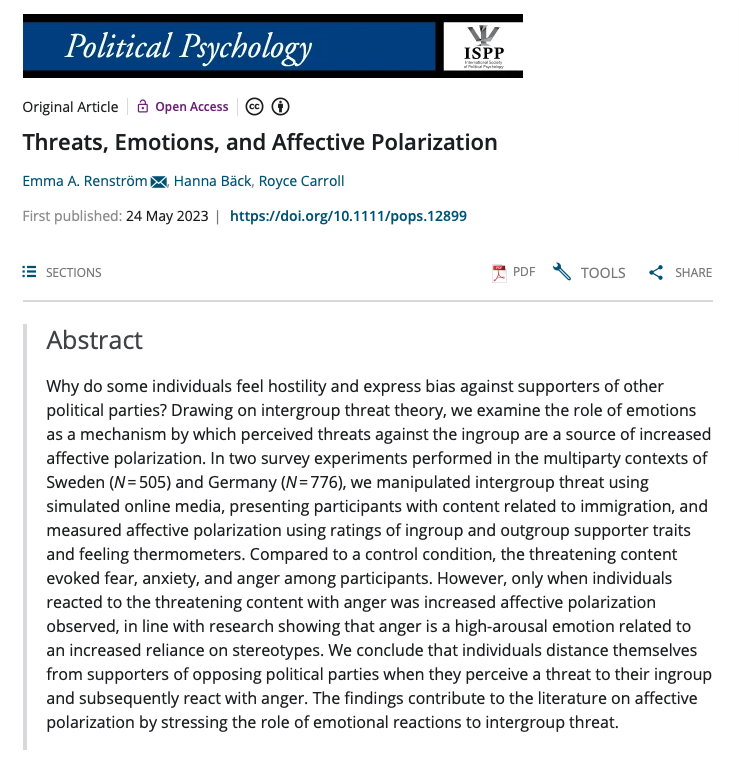
How does elite communication influence affective polarization between partisan groups?

In this recent publication, we explore how source cues influence perception of a message in terms of political identity and its consequences for affective polarization. Our analyses show that individuals who received a factual political message with a source cue from an in- or outgroup representative exhibited higher affective polarization, especially when they already held strong partisan affinities. This suggests that political elites can increase affective polarization by reinforcing existing group identities, and that this occurs in conjunction with biased interpretation of elite communication. The results improve our understanding of how political elites can influence affective polarization and add to previous research on party cues and attitude formation by demonstrating that such source cues can also increase intergroup differentiation.

The paper, which was recently published in Electoral Studies, can be found here.

Congratulations to Dr. Knapton!

Last week, Holly Knapton defended her thesis “From Exclusion to Extremism” at Lund University. The thesis can be found here.

Abstract

The present thesis aims to examine the causal role of social exclusion within the
radicalization process and further to explore moderating and mediating factors. In recent years there has been a move away from trying to understand who is at risk of becoming an extremist, to exploring what makes someone at risk. Feelings of exclusion, discrimination and marginalization have all been linked to participation in extremist activities. Yet to date there continues to be very little empirical data exploring the pathway of exclusion to extremism. This thesis plans to establish a causal link between exclusion and radicalization and explore the moderating and mediating factors that can impact this mechanism. Paper I found that social exclusion triggers a desire for recognition and this functions as a pathway to radicalization. Four experiments were conducted and found that exclusion was a driver of radical ideology in individuals sensitive to rejection. Further, the findings of these studies revealed that this effect was consistent across different social and political issues. Paper II revealed that the pathway of social exclusion on radical activism arises via shifts in ingroup identity. Specifically, the source of exclusion impacted ingroup identity shifts and in turn activism intentions. An online experiment revealed that exclusion by an outgroup (not ingroup) led to increased participation and this effect was fully mediated by ingroup identity. This finding was replicated using an online survey that operationalized exclusion via a measure of perceived discrimination. This demonstrated perceived discrimination by an outgroup, led to increased ingroup identity and in turn increased engagement. As such this study highlighted the impact of group-based exclusion and how this impacts identity levels and activism engagement. Paper III investigated the link between identity and exclusion one step further by adding need-threat to the mediation pathway. A quasi-experimental study revealed that exclusion led to threatened fundamental needs. This in turn drove individuals to identify with a radical group and be more willing to endorse and participate in extremist actions. The findings of the thesis highlight the vulnerability of individuals experiencing social exclusion and discrimination in relation to radicalization risk. The explanatory pathways described in the thesis help explain this mechanism and thus provide empirical data that can help shape informed counter-extremism strategies.

New postdoc

Alexander Ryan is a new postdoctoral fellow in the project “Polarizing pandemics. Identity, emotions, and attitudes toward Covid-19 prevention”. Alexander acquired his PhD in political science from Mid Sweden University in 2023. His dissertation centers on affective political polarization in the Nordic region, including how to measure and study the concept in multiparty contexts, examining explanations for differences in affective polarization and studying its political consequences. His work has appeared in journals such as Scandinavian Political Studies and Frontiers in Political Science.

New book out: "Coalition Agreements as Control Devices - Coalition Governance in Western and Eastern Europe"

Research team member Hanna Bäck co-authored a book in comparative politics that was published just a few days ago! Together with Heike Klüver and Svenja Krauss she has analysed the content of coalition agreements across a range of parliamentary democracies in Western and Eastern Europe.

The book is the first of its kind and it provides imperative insights as to how coalition agreements actually work. I.e., how coalition parties use negotiations to control their coalition partners when policiy issues are divisive and important or when confronting a hostile minister. Order your very own hard copy of the book here.

Member of the Royal Swedish Academy of Letters

Hanna was recently elected a new member of the Royal Swedish Academy of Letters. Queen Lovisa Ulrika founded Kongl. Swenska Witterhets Academien, the Royal Swedish Academy of Letters on 20 March 1753. Today, as the Royal Swedish Academy of Letters, History and Antiquities, the Academy advances and funds research in the humanities and social sciences and in cultural heritage management. Its work is financed by donations and by public and private foundations.

Read more in the press release (in Swedish).

Social dominance orientation and the moderating role of being single on misogynistic attitudes

A new article was recently published, exploring the role of entitlement, SDO, RWA and being single on misogynistic attitudes among American heterosexual men. The article can be found here.

Abstract

This article aimed to explore individual level factors as predictors of misogynistic attitudes. Given that misogyny and activity on online forums related to so called incel-dom is growing and has been identified as a terrorist threat, it becomes important to better understand the underpinnings of misogynistic attitudes, also in a normal population. Based on previous research and theory, entitlement, Social Dominance Orientation and Right-wing authoritarianism was explored as well as the moderating role of being single among American men (N = 302). Results from an online survey showed that all three predictors as well as being single (compared to being in a relationship) significantly predicted misogynistic attitudes. The effect of SDO was moderated by relationship status such that singles who were high SDO expressed most misogyny. The results contribute to a better understanding of who may come to adhere to a more radical view of women.

New research assistant

We have hired a new research assistant, Maya. Maya will mainly work with the incel project but also with the other projects.

Maya has a MSc in applied social psychology from Groningen University, The Netherlands. Her main area of interest lies within social and cultural dynamics. More specifically, she has studied social grounding, and how social norms are formed and maintained regarding sexual behavior and beliefs. Additionally, she is interested in group polarization and radicalization processes, and aims to clarify why some people come to hold extremist and hostile views about certain matters or other people.

Two large grants awarded to the research group

The research group recently was awarded with two large research grants.

The first “Incels and the manosphere” will explore the incel movement and misogynistic radicalization in Sweden. The grant was awarded by Forte, for three years.

The second “A divided digitalized democracy” will explore affective polarization as a spiral between the political elite and the masses. This grant was afforded by Vetenskapsrådet, for three years.

New paper on radicalization

Holly, Emma and Magnus just published a new paper on radicalization in the backdrop of the abortion divide in the US. The paper titled The abortion divide: Exploring the role of exclusion, loss of significance and identity in the radicalization process was published in Frontiers and can be found here.

Abstract

Introduction: Recently, the abortion issue has entered the spotlight in the USA, leading to potential radical actions. As the majority opinion on the abortion issue vary with state, some individuals will be in the numerical minority within their state, possibly evoking feelings of exclusion. Social exclusion can motivate a radicalization process. The aim of this paper is to explore how individuals in a numerical minority experience feelings of exclusion and significance loss and how this may drive radicalization in the context of the abortion issue.

Methods: A quasi-experimental design was used and 534 respondents from naturally occurring numerical minority and majority groups based on state abortion opinion participated in an online survey.

Results: Results showed that those in the numerical minority experienced exclusion and were more willing to engage in and endorse radical actions compared to those in the majority, regardless of position on the abortion issue. Serial mediation analysis revealed that the pathway between minority group status and engagement and endorsement of extreme actions was fully mediated by need-threat and ingroup identity.

Discussion: Being in the numerical minority is associated with feelings of social exclusion, which may trigger a radicalization process. The results advance our understanding of when and who is vulnerable to radicalization and that social structures that perpetuate marginalization and inequality may contribute to radicalization. Results highlight the need to continue to explore radicalization from a group-based perspective and emphasize exploring mediating factors as a pathway from social experiences to willingness to engage with radical groups.

Hanna interviewed about potential effects of affective polarization on government formation (in Swedish)


Med en dryg vecka kvar till valet är tonläget i politiken högt och polariseringen tydlig. Men skiljaktigheterna handlar inte bara om ideologi och åsikter. Man är också benägen att tycka att motståndarna är oärliga, ointelligenta och fördomsfulla. Det visar forskare vid Lunds och Göteborgs universitet i en studie om så kallad affektiv polarisering.

Läs hela inlägget från Lunds universitets hemsida här.


New blog post about affective polarization (in Swedish)

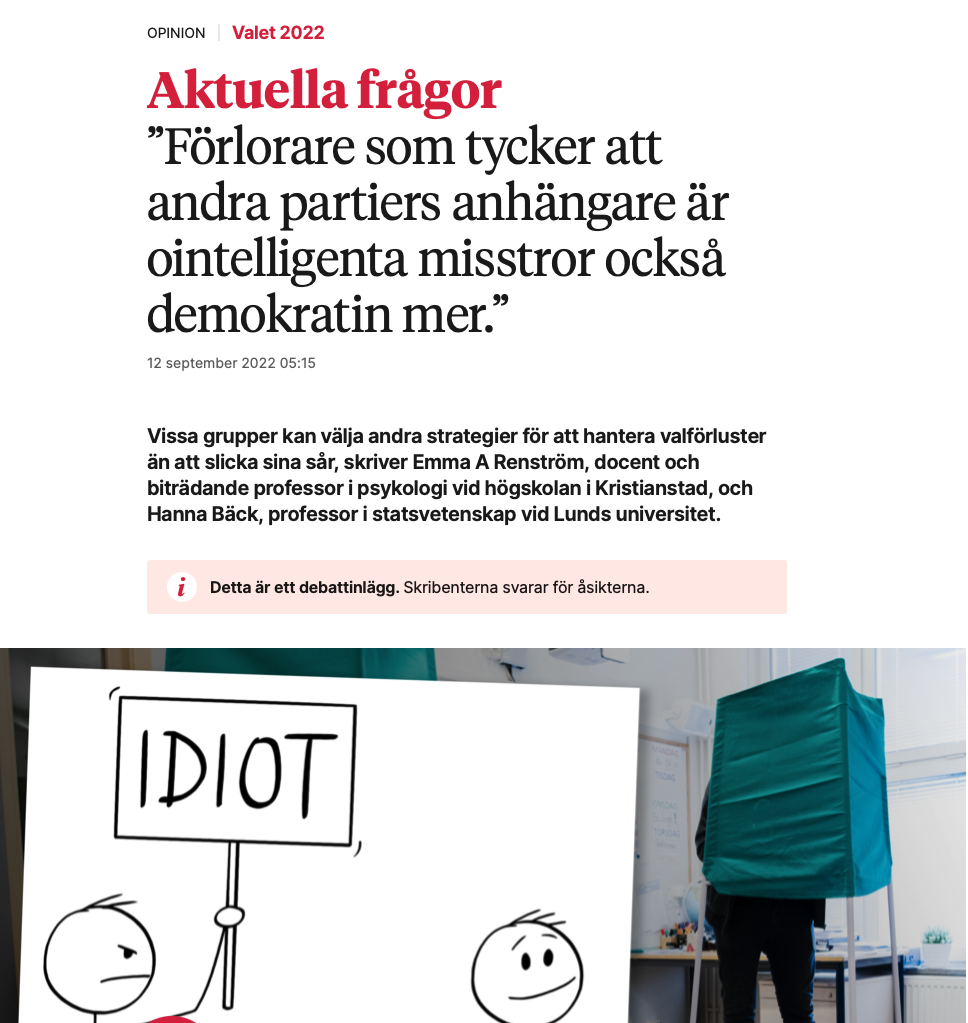
Hanna och Emma har skrivit ett blogg-inlägg på Makt och Politik om affektiv polarisering.

Valrörelsen är i full gång och partiernas representanter uttalar sig i mer eller mindre negativa ordalag om motståndarsidan och utmålar vissa andra partier som fiender. Detta kan ha stor betydelse för hur väljarna ser på andra partier och deras anhängare, och för den så kallade polariseringen i väljarkåren.